
report_problem Problem Definition
Problem Situation Exploration
A digital divide exists in the Droflas community, situated in the northwestern part of the United Kingdom. Some individuals are unable to use digital tools like computers and the internet, primarily due to financial constraints. This issue affects not only these individuals but also their children, who form 34.8% of the child population. These children attend local schools that heavily rely on technology for teaching, causing them to lag behind their peers and limiting their future opportunities.
Sara and her children represent a clear example of people who face barriers related to physical access to technology and the skills required to use these technologies effectively. Their circumstances reflect what many families in similar situations experience daily. She is unable to access essential government services and job opportunities that require digital proficiency, as she lacks the necessary skills. This issue can be characterized as a very complex one because the lack of access to digital technology hinders the development of digital skills, ultimately affecting prospects and job opportunities. This cycle further affects their ability to afford digital devices, adding to the challenge. Although the city council has made efforts to introduce innovations aimed at bridging the digital divide in the community, these initiatives have not reached everyone effectively. There are reasons behind this ineffectiveness that need to be explored further. Ultimately, the digital divide in the Droflas community presents a complex challenge that extends beyond mere access to technology and affects education, employment, and overall well-being.
To tackle this problem, we'll use the Soft System's Methodology (SSM), developed by Peter Checkland in the 1980s. This method comprises multiple systematic steps that we'll follow to thoroughly break down the issue of the digital divide in the Droflas community. We'll then present comprehensive solutions, actionable plans, and effective strategies for managing the changes needed to put these solutions into practice. The effectiveness of the SSM approach, as demonstrated by Devi et al. (2023), lies in its ability to identify current processes and suggest improvements or entirely new and more efficient processes to meet both present and future needs. Moreover, Checkland and Poulter (2006) emphasize that the versatility of SSM extends across diverse domains, showcasing its suitability for various situations and contexts.
account_tree Systems Visualization
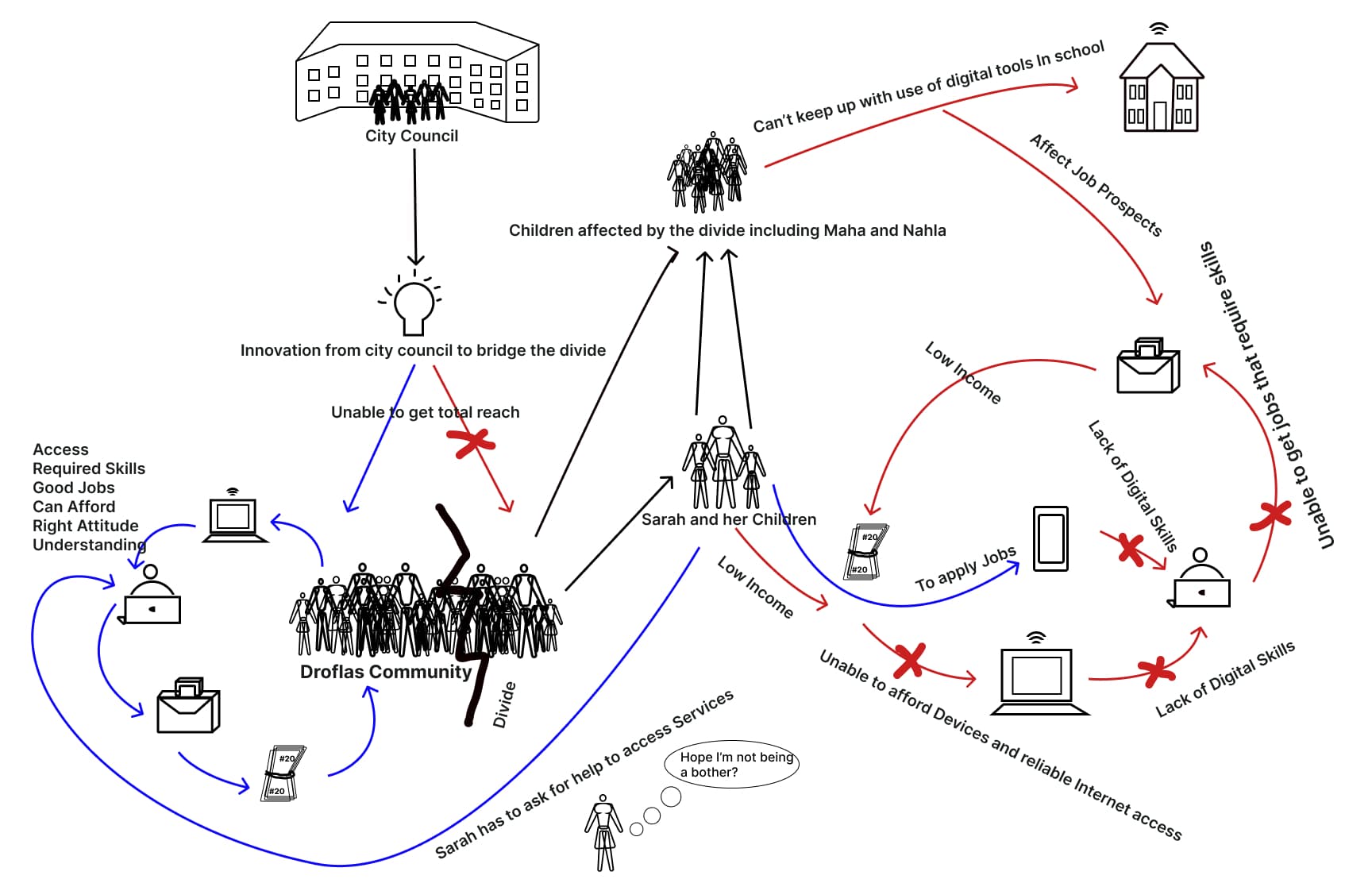
Rich Picture
We are going to be using a rich picture to represent the current situation in the Droflas community.
psychology CATWOE Framework
To develop the root definition, we will be doing a CATWOE analysis from the perspectives of each of these two major stakeholder groups, which are the members of the Droflas community and the Droflas city council.
Droflas Community
Customers
Individuals in the Droflas community who strive to provide for their families' needs... includes the families of the children who come from poor backgrounds (34.8%).
Actors
Members of the Droflas community, the Droflas city council, the employers, the schools and school administrators, and family and friends.
Transformation
To make digital devices more affordable, reliable internet connections more accessible, and to empower them with digital skills.
Worldview
People just want to be able to get easy access to the basic services that they need, get stable jobs, earn a good income.
Owners
The Droflas city council.
Environment
Employers require skilled people to apply for jobs... A good job is needed to be able to afford digital devices.
Droflas Council
Customers
Individuals in the Droflas community who lack access to technology and also lack digital skills.
Actors
Members of the Droflas community, the Droflas city council, the telecommunication companies, the university, and the schools.
Transformation
To bridge the digital divide in the Droflas community and also teach digital literacy.
Worldview
The world is constantly changing and is going digital, and everyone has to keep up.
Owners
The Droflas city council.
Environment
Limited awareness and resources within the community might pose challenges.
account_tree Conceptual Model
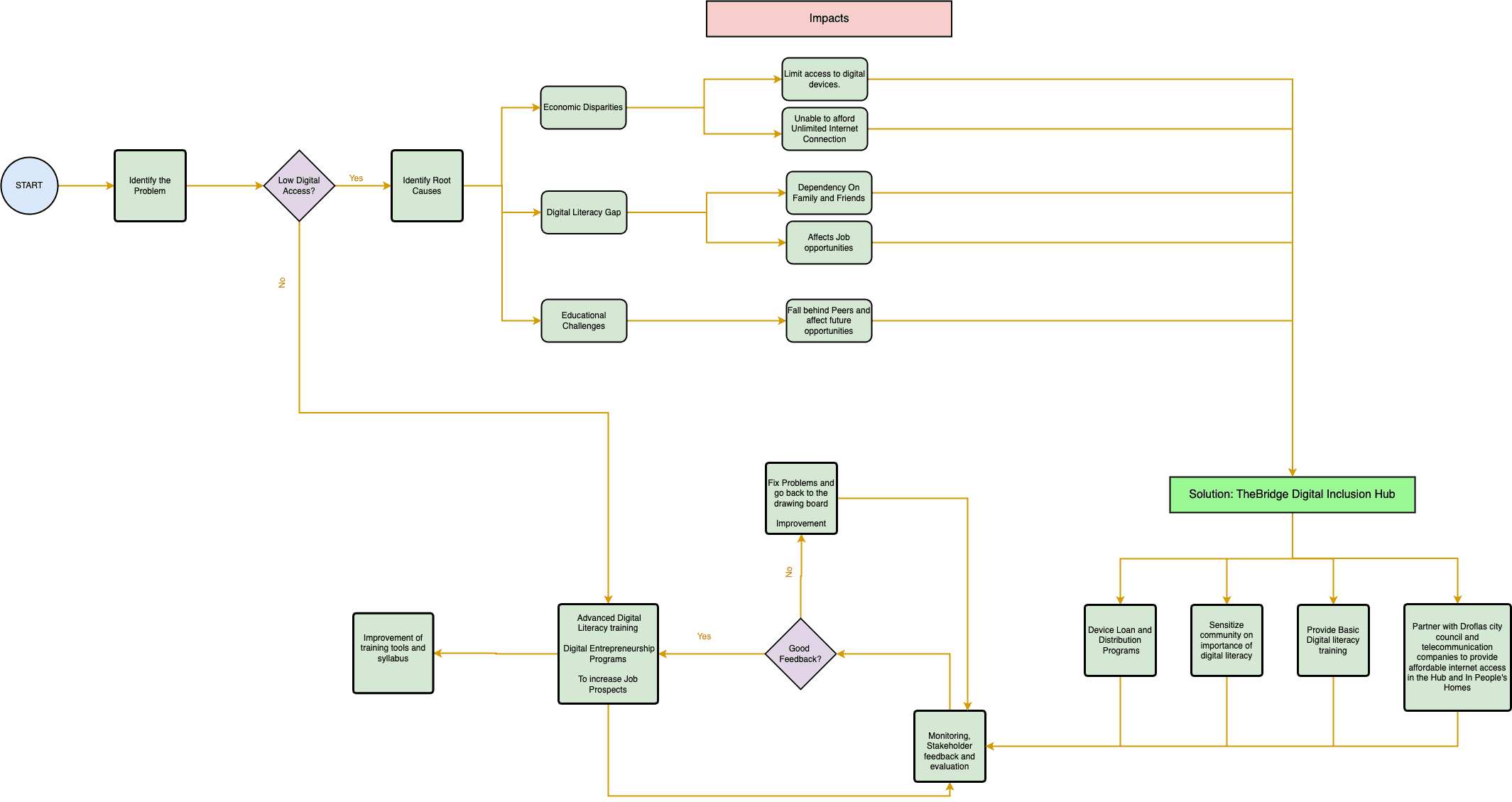
In the conceptual model, we start by identifying the problem in the community. If the problem is low digital access, we proceed to identify the root causes, which in this case include economic disparities, the digital literacy gap, and educational challenges, and also highlight the respective impacts of these problems, which are limited access to digital devices, the inability to afford unlimited internet connection, dependency on family and friends, affected job opportunities, and children falling behind peers and losing out on future opportunities. We then move on to the solution to improve this system and make it better, which includes our digital inclusion hub, where we will sensitize the community to the importance of digital literacy and digital inclusion, loan and distribute devices to families and people who can't afford them, Provide basic digital literacy training and partner with Droflas City Council and telecommunication companies to provide affordable internet access in the hub and in people's homes. We will also continue to monitor and evaluate this process and ask for feedback. If we receive negative feedback, we will make improvements based on the feedback and continue to evaluate because we care about the community. Once we are able to fit everyone's needs, we will now carry out advanced digital literacy programs and digital entrepreneurship programs to increase the job prospects of people in the community. For people who are not affected by low digital access, we will also advise them to take the digital literacy and digital entrepreneurship programs. As time goes on, we will continue to update the tools and syllabus used in trainings and in the hub to ensure that we are up to speed with the current trends.
grid_view Strategic SWOT Matrix
- Comprehensive approach covering access, education, awareness, skills, and finances.
- Involves multiple stakeholders (Droflas Council, telecom, community) ensuring a tailored approach.
- Focuses on sensitizing the community to eliminate attitudinal barriers.
- Resource intensive (funding and logistics for hub, laptops, internet).
- Difficult to offer training to diverse demographics with varying familiarity.
- Outcome depends on community's willingness.
- Depends heavily on stakeholder collaboration.
- Increased employability, improved education, and enhanced access to services.
- Partnerships can bring resources, funding, and expertise.
- Increasing importance of digital skills presents an opportunity to empower individuals.
- Can be mirrored in other communities if successful.
- Lack of funding may hinder implementation.
- Resistance from the community due to cultural beliefs or skepticism.
- Competing priorities for community needs.
assignment Strategic Action Plans
Pitch, Collaboration, and Securing Funding
Organize meetings, present ideas, seek collaborations and funding options.
Preparing training materials
Develop tailored curriculum and engaging training materials.
Surveys & Sensitization
Conduct surveys to understand needs and organize awareness campaigns.
Hub Setup & Training
Set up physical hub, launch training programs, and start laptop loan program.
sync Change Management
Continuous Learning and Adaptation
This step is extremely important and builds upon the process of feedback monitoring and evaluation in our action plan. In this stage, we will also put our change management plan into action.
- Collaborate with Community Leaders: Identify and work with local leaders to promote benefits.
- Setting Goals: Decide on things we want to achieve (monthly and yearly goals).
- Monitor and Address Concerns: Monitor progress and address any issues.
- Celebrating Success: Celebrate milestones with the community.
- Learning and Improving: Ask for feedback, evaluate milestones, and make changes.